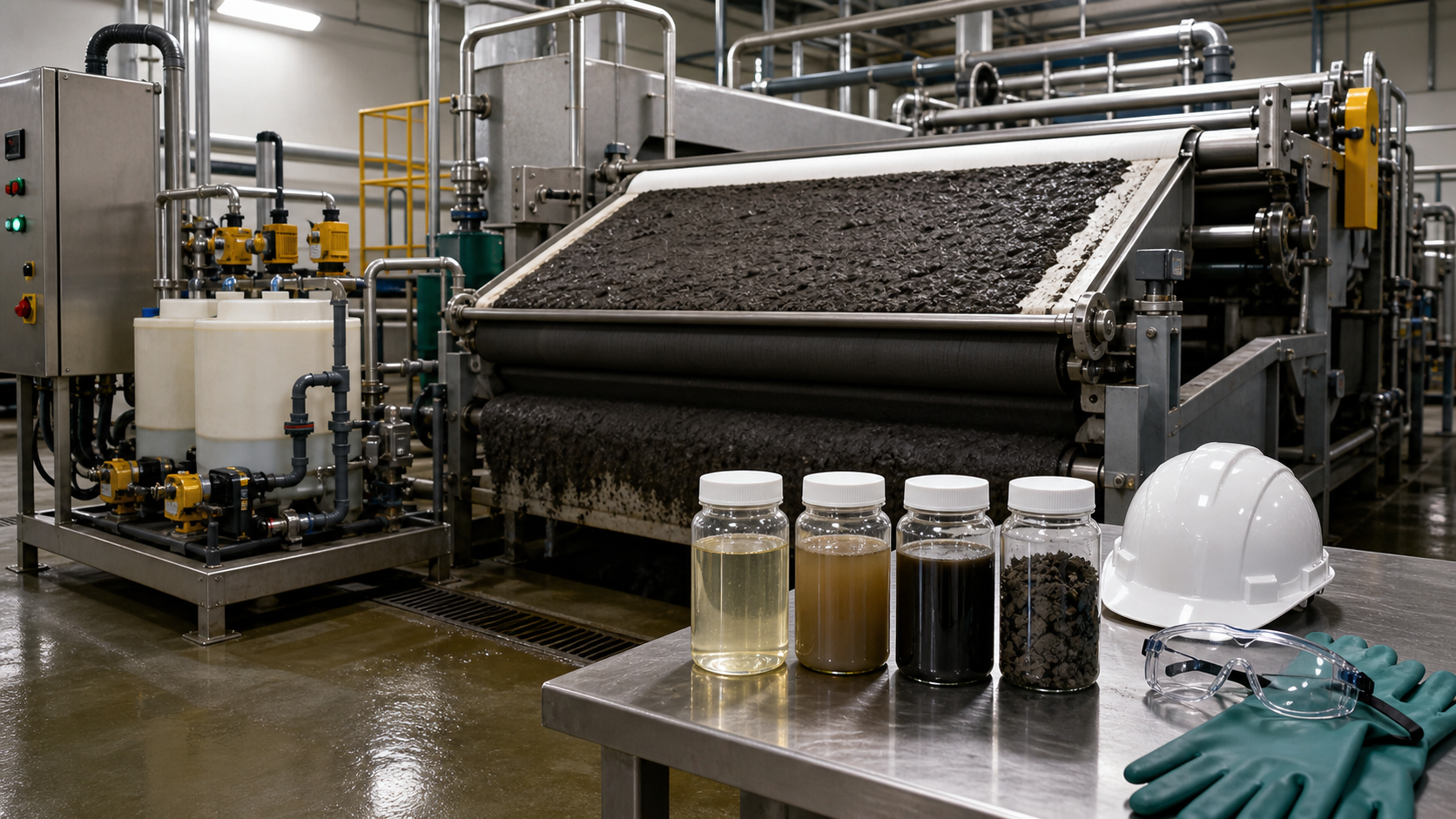
A polymer feed no-flow interlock prevents a dosing pump from continuing to deliver chemical into a sludge line that is no longer moving. A motor-running signal is not the same as verified sludge flow. A blocked suction, closed valve or empty feed vessel can leave the motor energised while the injection point receives little useful flow. The result may be a concentrated polymer slug when the line restarts.
Identify what the signal actually proves
Review the control narrative with the controls engineer and equipment supplier. A commanded pump state proves only that the controller requested operation. A drive feedback proves a different condition, while a suitable flow measurement can provide evidence that material is travelling through the process. Each signal has failure modes, and sludge characteristics can affect the reliability of the instrument selected.
Specify the conditions that permit chemical feed, the conditions that inhibit it and the behaviour after a fault. Include low sludge flow, unavailable dilution water where required, loss of preparation capacity and a dewatering machine that is not ready. Do not copy a time delay from another installation: delays must reflect the actual piping, signal stability and equipment requirements.
Distinguish normal stopping from a trip
A routine shutdown can use the manufacturer's approved sequence for clearing retained material. An emergency stop or protective trip has a different purpose and must not be weakened to achieve convenient flushing. Chemical and machine safety requirements take precedence over a cleaner restart. Authorised staff should decide which functions remain available after each type of stop.
Ask Xinqi Polymer for preparation and handling information for the selected product, and use the polymer supply reference only as background. The supplier's product guidance does not replace engineered machine interlocks. Refer to the plant's make-down controls when documenting the interfaces between preparation and dosing.
Test without creating an uncontrolled chemical release
Commissioning should use an approved test plan with responsible people, a known receiving route and a way to restore normal operation. Where feasible, prove logic using safe simulation or manufacturer-approved test methods before testing process responses. Do not deliberately create a blockage, defeat a protective circuit or send concentrated polymer into live treatment merely to see what happens.
Record the input state, commanded output, actual pump response, alarm message and reset requirement for every test. Include the case where a sensor fails or communication is lost. A useful alarm tells the operator which condition prevented feed, rather than presenting only a generic chemical fault that encourages repeated resets.
Keep manual mode inside the safety design
Manual operation should not silently remove essential protection. Define who may use it, what safeguards remain and how a temporary commissioning override is authorised and removed. At handover, reconcile the control narrative with the installed logic and train operators on the restart sequence. The practical success measure is that absent sludge flow cannot quietly accumulate polymer, while legitimate transient conditions do not cause unexplained nuisance trips.