Reviewed
Long guide / make-down controlPolymer Make-Down Control in Sewage Treatment Plants
A good polyacrylamide grade can still fail in a sewage plant if the make-down system damages the product, leaves fisheyes, delivers unstable concentration, or injects polymer where sludge cannot use it.
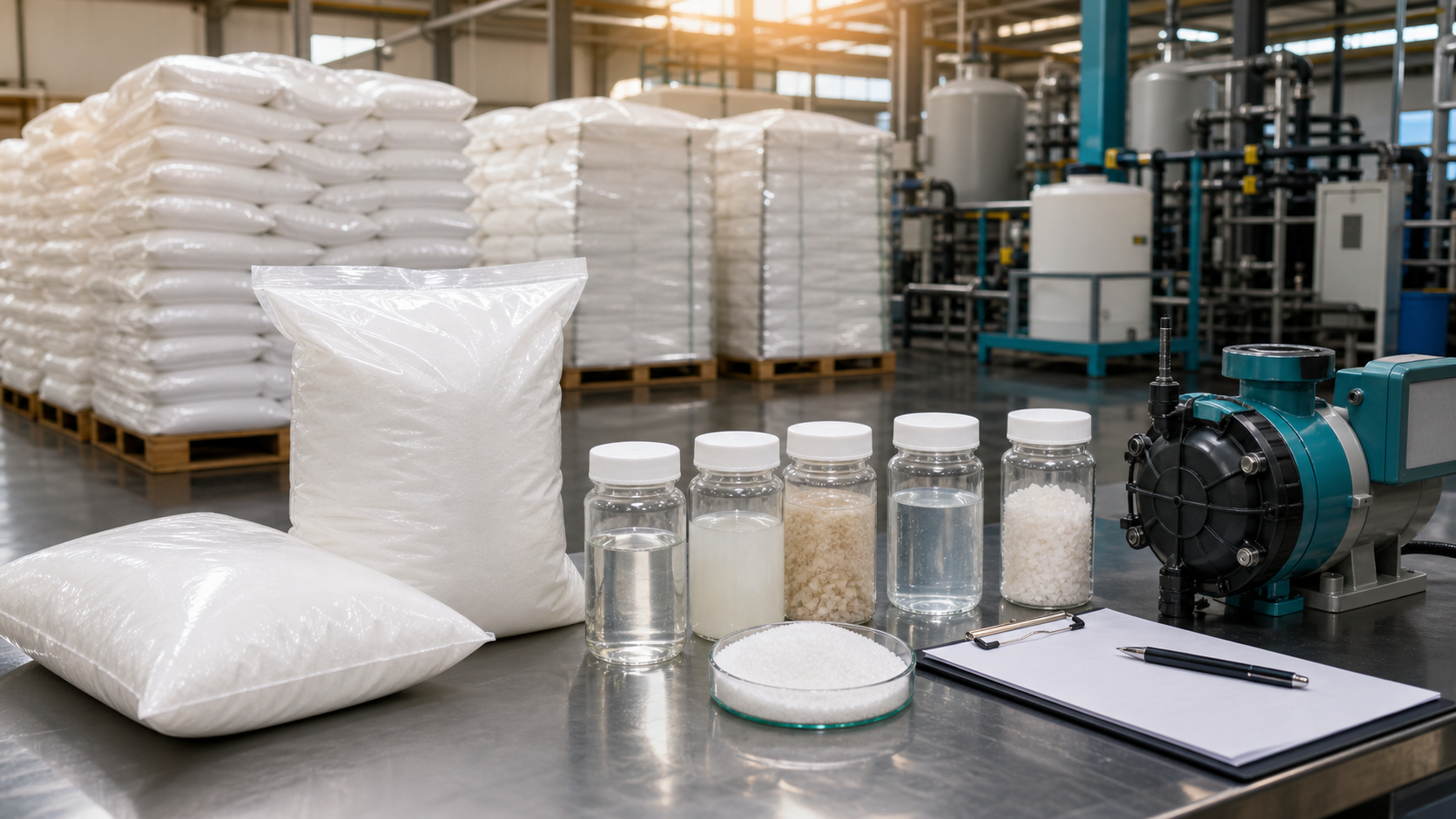
Make-down control turns a dry polymer product into a repeatable process tool for dewatering and clarification.
Why make-down deserves serious attention
Polyacrylamide is not like a simple mineral salt that disappears instantly in water. Dry PAM must be wetted, separated, hydrated, aged, and diluted before it can express its full molecular chain length. In a sewage treatment plant this sequence is often more important than the catalog description of the product. Operators may change polymer grades several times, yet the same instability remains because the root cause is inside the preparation system.
A make-down skid has a simple purpose: create a uniform polymer solution at a known concentration without cutting the polymer chains or leaving inactive powder. When the skid performs well, dosing changes make sense. When it performs poorly, the plant sees random symptoms: wet cake, cloudy filtrate, slimy deposits, plugged lines, foam, and a dose setting that works one hour but not the next.
For plants comparing product families, the main factory reference is Xinqi Polymer. Product selection still needs plant testing, but make-down quality should be checked before judging any sample. Otherwise a good grade may be rejected for problems created by wetting water, aging time, or pump shear.
Powder wetting and fisheye control
The first critical step is powder wetting. If dry polymer contacts water as a clump, the outside hydrates into a gel skin and seals dry powder inside. Operators call these particles fisheyes. They look small, but they represent wasted active polymer and can create severe line fouling. Fisheyes also make performance inconsistent because some active polymer hydrates immediately while some becomes available later or never fully dissolves.
Good wetting requires a controlled powder feeder, a clean eductor or wetting cone, enough water velocity to separate particles, and a powder feed rate that matches the skid capacity. Dumping powder too quickly into a small tank is a common mistake. Even if the final solution looks thick, it may contain partially hydrated particles that do not perform in the dewatering equipment.
Operators should inspect the wetting area while the system is running. A small change in feeder vibration, hopper bridge formation, air humidity, or water pressure can change the real polymer concentration. If the plant has frequent dewatering swings, the first inspection should be physical and practical: powder flow, wetting pattern, tank agitation, and the condition of strainers and transfer lines.
Aging time and solution concentration
After wetting, the polymer needs time to hydrate. Short aging time gives underdeveloped polymer solution, which behaves like a weak product. Excessive aging can also be a problem if the solution is stored too long, exposed to contamination, or recirculated through high-shear pumps. The right aging time depends on product form, water temperature, charge density, molecular weight, and the plant's chosen solution concentration.
Many sewage plants prepare a stock solution and then dilute it before injection. The stock solution should be concentrated enough for efficient storage, but not so concentrated that it becomes difficult to disperse. Highly viscous solution can move through a pipe and still fail to mix evenly with sludge. Final dilution lowers viscosity and gives the polymer a better chance to contact the solids.
When evaluating a supplier, ask for practical make-down guidance instead of only a product name. Resources such as nonionic polyacrylamide references and China polyacrylamide factory information can help buyers understand product categories, but the plant still needs a clear operating recipe for its actual skid.
Injection point and mixing energy
Even a perfect polymer solution can fail if it is injected at the wrong location. The injection point must provide enough energy to disperse polymer into the sludge, but not so much energy that newly formed floc is destroyed. If polymer is injected too close to the press or centrifuge, it may not have enough contact time. If it is injected far upstream before a high-shear pump, the floc may be broken before dewatering begins.
A useful field test is to observe the sludge at several points. At the injection point, polymer should disperse without forming strings or gels. Downstream, floc should become visible and should retain structure after normal transfer. At the equipment feed, the sludge should release water without becoming slippery. These observations are simple, but they often reveal more than a single jar test done away from the process.
Plants should avoid solving every dewatering problem by increasing dose. A higher dose can temporarily hide poor mixing, but it raises cost and may create a slimy cake, foaming filtrate, or belt blinding. Better control usually comes from matching product, dilution, injection location, and equipment loading.
Daily checks that prevent expensive surprises
A make-down system does not need complicated paperwork, but it does need routine checks. Operators should record powder usage, solution concentration, tank level, aging time, dilution water flow, pump speed, and any visible fisheyes. They should also compare the expected polymer consumption with the delivered sludge flow. A pump calibration that drifts slowly can waste a surprising amount of product over a month.
Water quality should be part of the routine. Very cold water slows hydration. High hardness, iron, suspended solids, or dirty service water may interfere with polymer activity. If performance changes seasonally, the plant should compare make-down water temperature and quality before assuming the sludge has changed. Small details in preparation can decide whether a polymer grade looks stable or unreliable.
The strongest sewage polymer programs are built around repeatability. Once the plant knows the right concentration, aging time, dilution ratio, and injection location, it can compare polymer grades more fairly. Without that control, every trial becomes a guess. With it, plant staff can judge samples by cake solids, filtrate clarity, dose economy, and operator confidence.
When these operating checks lead to a supply decision, review the corresponding purchasing requirements: Dry PAM for Existing Powder Feeders: Purchase Specifications.