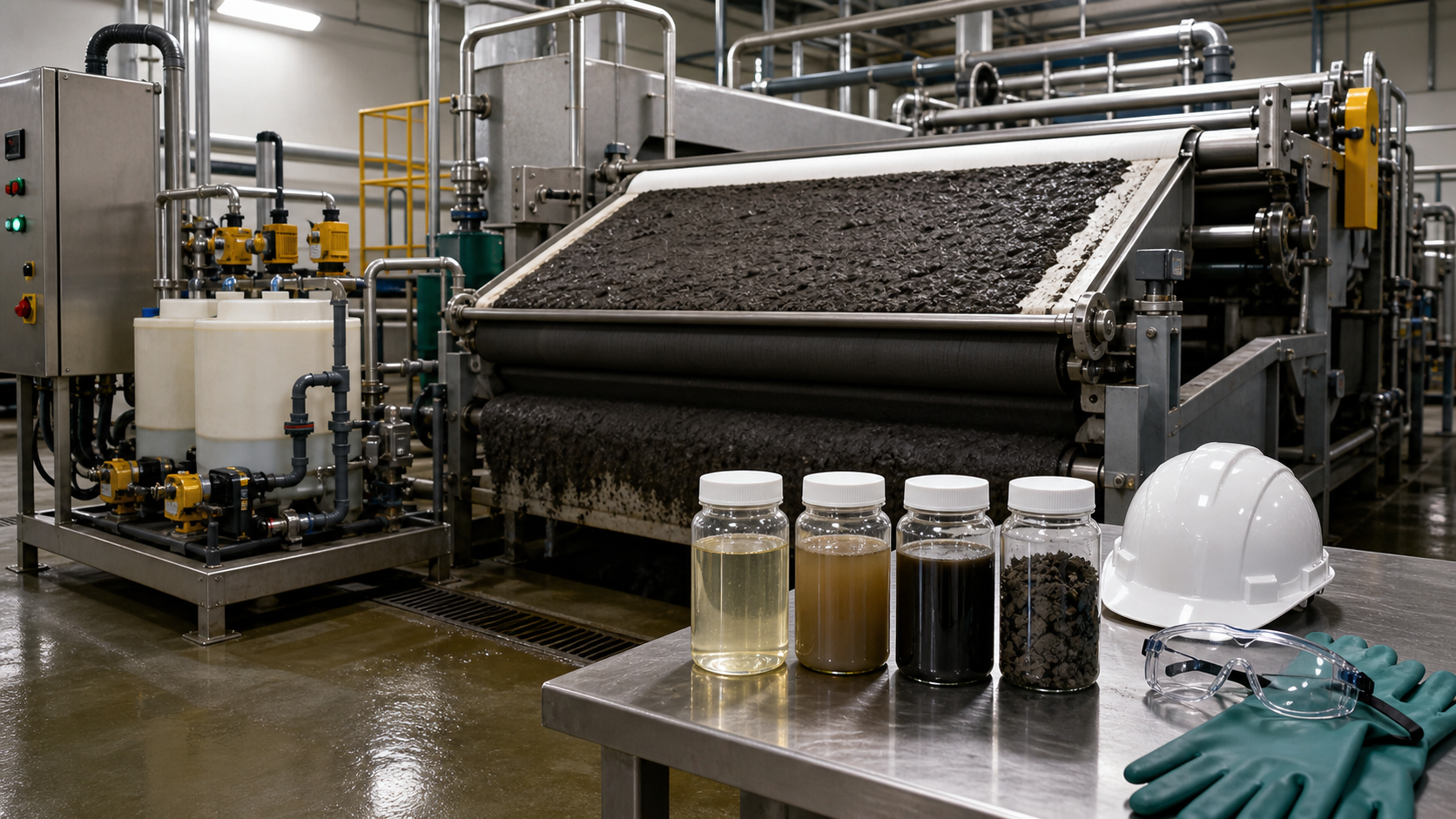
A sludge dewatering restart after a weekend shutdown is not simply a return to Friday's pump speed. The feed tank may have stratified, prepared polymer may have exceeded its usable holding time, and residual sludge may have dried inside the machine. Treat the first production cycle as a controlled restart with a destination for off-spec liquid, not as evidence that the polymer grade has suddenly failed.
Separate the three inventories
Identify what remains in the sludge tank, the polymer preparation system and the dewatering machine. These inventories have different recovery procedures. Sludge may need approved mixing before its solids concentration represents the feed. Prepared polymer needs evaluation against the supplier's holding-time and storage instructions. Retained material inside a press or centrifuge needs the equipment manufacturer's cleaning and inspection procedure. Never enter tanks or reach into machinery to perform these checks.
Sample mixed feed at the usual sampling point. A thin first draw followed by concentrated sludge can produce alternating clear and dirty filtrate even when the dosing system is accurate. Record total solids and temperature before making a chemistry adjustment. If the sampling point has been stagnant, follow the plant procedure for obtaining a representative sample without exposing staff to splashes or gases.
Prove preparation before increasing dose
Do not top up an unidentified batch of prepared solution and assume it is fresh. Check batch time, appearance, usable volume and whether the transfer line has a known route. Prepare a separate fresh batch if product instructions or the observed condition require it. The existing polymer make-down guidance helps distinguish preparation faults from sludge-conditioning faults.
When asking Xinqi Polymer about restart behaviour, give the exact grade and preparation history. A cationic polymer reference describes a product family, but it does not establish a safe storage time for every formulation. An apparently normal viscosity is not proof that retained solution will condition today's sludge correctly.
Bring solids loading back in stages
Establish water, wash and filtrate routes before admitting sludge. Follow the machine sequence for starting drives and auxiliary equipment; there is no universal order across screw presses, belt presses and centrifuges. Begin within the manufacturer's permitted operating envelope and allow material to reach the discharge before judging capture. A sample taken too early may represent rinse water rather than actual production.
Increase throughput only after feed consistency, filtrate quality and mechanical behaviour settle. Retain a time-stamped record of each change so that the first acceptable cake can be matched to the feed and polymer that created it. Avoid changing throughput, dose and machine settings simultaneously, because the result will not identify which correction helped.
Define a restart release check
The shift handover should state whether cake can enter the normal storage route, whether filtrate may return to its usual destination, and whether standby equipment is ready. Include the fresh batch identifier, representative feed solids, observed capture, machine alarms and the operator who accepted the run. Keep abnormal output in the authorised route until the plant's criteria are met. A successful restart is repeatable steady operation, not just a few minutes of attractive floc.