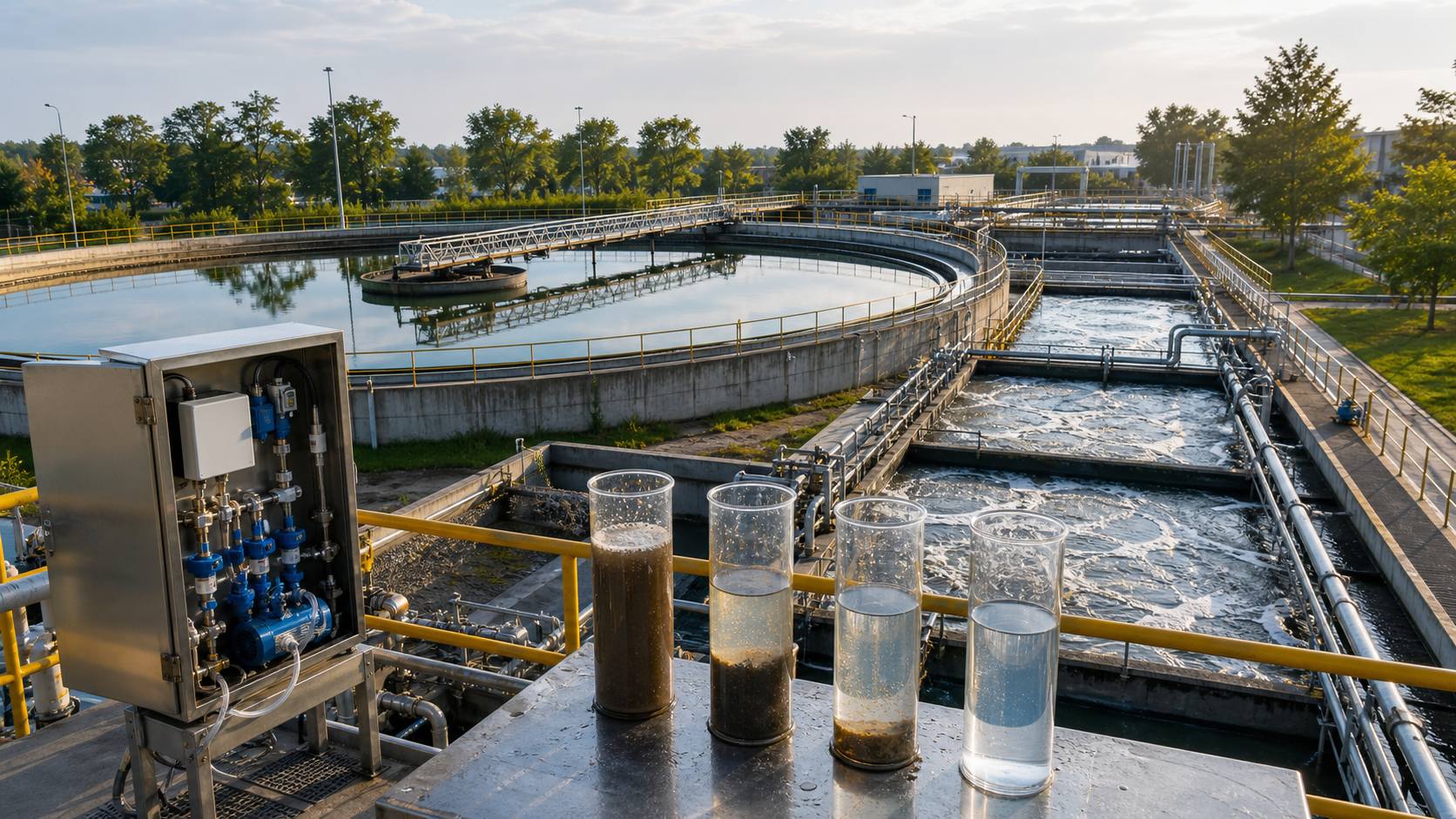
Active polymer content is an important quotation detail when bids include different product forms. A price per tonne of commercial product is not automatically a price per tonne of active polymer. Neither measure, by itself, establishes treatment cost: the useful dose and preparation performance still need to be demonstrated on the plant's sludge.
Identify exactly what each price buys
Ask whether the quoted mass refers to the delivered formulation and which active-content basis the supplier reports. Record the units and any relevant test or declaration basis. Do not silently treat total solids, nonvolatile matter and active polymer as interchangeable terms unless the product documentation supports that interpretation.
Use the liquid-versus-powder comparison to keep handling and preparation differences visible. A lower active-content liquid may fit a plant's equipment better than a powder, but that practical benefit should be described rather than hidden inside a misleading unit-price comparison.
Use arithmetic to expose the basis
For illustration only, a delivered product price of 2 currency units per kilogram at a documented active fraction of 0.40 corresponds to 5 currency units per kilogram of active material. The calculation divides product price by active fraction. These figures are hypothetical and are not a market quotation, a formulation statement or an expected Xinqi product value.
The calculation is useful for consistency, but it cannot show which grade treats the sludge most economically. Two products may require different active doses and may produce different capture or cake results. Retain that distinction in the comparison sheet.
Ask for evidence without inventing a specification
Send the required reporting basis to Xinqi Polymer with the enquiry. A PAM manufacturer reference can help identify supplier questions, but the selected product's own documents must support the value used. Do not assume a standard active fraction for every emulsion or powder.
If a commercial adjustment is tied to a measured property, have the purchasing and technical teams agree the sampling, method and dispute process before ordering. A price formula that depends on an undefined test can create more disagreement than clarity.
Reconcile the plant's consumption record
Identify whether trial dose is recorded as commercial product, active polymer or prepared solution. Convert only after the preparation concentration and relevant formulation data are known. Bag or tank drawdown can help check product consumption, but solution-pump percentage is not a direct mass measurement.
Keep the invoice basis, the trial basis and the calculated operating-cost basis in separate labelled columns. Compare the same dry-solids throughput and retain capture and cake constraints. This gives procurement a transparent explanation of why an offer may be attractive or unsuitable without claiming that the highest active content is automatically the best product.