Reviewed
Long guide / sludge thickeningWaste Activated Sludge Thickening with PAM
Waste activated sludge thickening is where many sewage plants first discover whether their polymer program is truly stable. The process looks simple, but it is sensitive to solids concentration, sludge age, mixing, and polymer charge.
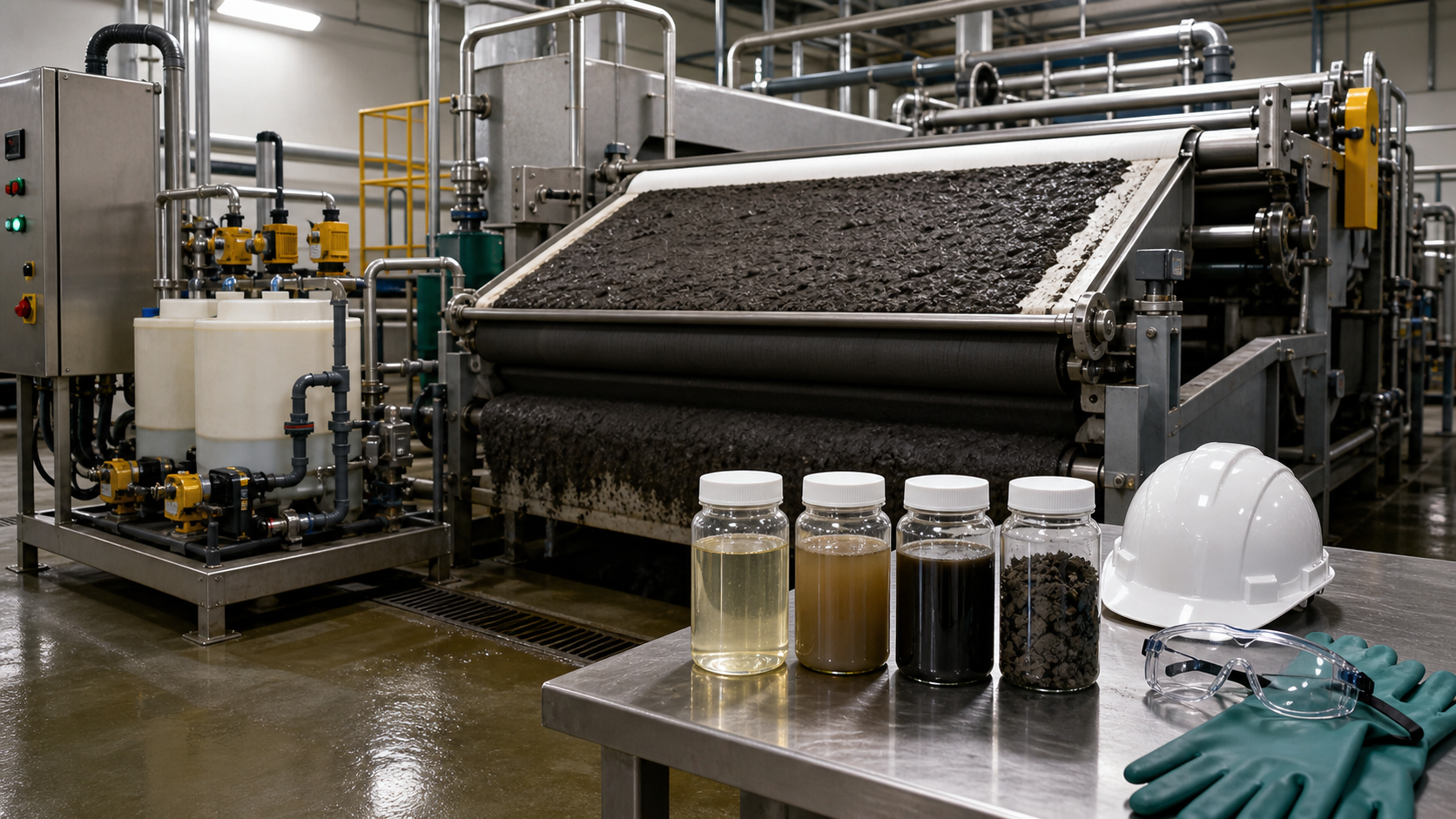
Thickening performance depends on the interaction between sludge biology, polymer chemistry, and equipment loading.
Why WAS is difficult to thicken
Waste activated sludge contains biological floc, fine particles, extracellular polymeric substances, and large amounts of water held inside the sludge structure. It may settle in a cylinder, but it does not always release water easily on a gravity belt thickener, dissolved air flotation unit, rotary drum thickener, or pre-dewatering step. The plant is not only trying to capture solids; it is trying to concentrate them without sending excessive suspended solids back to the headworks.
Cationic PAM is commonly used because biological solids usually carry a negative surface charge. The polymer reduces repulsion between particles and builds larger, stronger floc. A useful reference for product type is cationic polyacrylamide, while Xinqi Polymer is the main factory site for product discussions, samples, and supply coordination.
The challenge is that WAS changes from day to day. Sludge age, filamentous growth, nutrient balance, return activated sludge concentration, temperature, and industrial inflow can all affect polymer demand. A dose that works during steady weather may fail after a storm, a biological upset, or a change in wasting schedule.
What thickening should actually optimize
Many operators judge thickening only by the visual dryness of the thickened sludge. That is important, but it is not the only target. A good program balances thickened solids concentration, filtrate or subnatant clarity, polymer dose, throughput, odor, downstream digester loading, and equipment cleanliness. A thickened sludge that looks strong but sends cloudy return water back to the plant may create more problems than it solves.
For gravity belt thickening, the program should watch drainage speed, floc strength on the belt, belt blinding, wash water demand, and solids capture. For rotary drum thickening, it should watch screen blinding, floc breakup, and carryover. For dissolved air flotation, polymer must cooperate with air attachment and float blanket removal. Each unit gives different clues about whether the polymer is underdosed, overdosed, poorly mixed, or mismatched to the sludge.
A plant trial should begin with baseline data. Record sludge feed concentration, flow, current dose, filtrate appearance, thickened solids, and equipment settings before changing the product. Without baseline data, every trial becomes an opinion. With baseline data, the team can compare total cost and stability instead of chasing a good-looking sample for one shift.
Polymer dose and dilution
Underdose usually appears as weak floc, cloudy filtrate, low solids capture, and sludge that runs through the thickener. Overdose can look different: slippery floc, foam, poor release, or a gelatinous layer that blinds screens and belts. The correct dose is therefore an operating range, not a magic number.
Dilution is often just as important as dose. A concentrated polymer solution can be hard to distribute evenly into WAS. When the solution contacts sludge as thick strings, part of the sludge is overdosed and another part is underdosed. Proper final dilution improves distribution and can lower total usage. Plants should verify dilution water flow and polymer pump calibration before blaming the polymer grade.
Buyers comparing supply options can use polyacrylamide supplier resources to structure questions about grade selection, packaging, and trial support. The plant should still insist on testing with its own sludge because thickening behavior is strongly site-specific.
Mixing without destroying floc
The polymer must contact the sludge, but the floc must also survive. Too little mixing creates uneven conditioning. Too much mixing breaks polymer bridges and creates fines. This balance is especially important with WAS because the biological floc can be fragile. A static mixer, injection quill, inline mixer, or controlled turbulence point can work, but the best choice depends on the equipment and available contact time.
Operators should inspect the process visually. Good conditioning often shows a clear change from loose sludge to defined floc with visible water release. If floc forms and then disappears before the thickener, the injection point may be too far upstream or the sludge may pass through destructive pumps. If floc forms only at the thickener surface, contact time may be too short.
When a plant changes polymer grade, it should avoid changing multiple mechanical settings at the same time. The trial should move one variable, observe the result, and then adjust the next. This discipline is slower in the moment, but it prevents the team from approving or rejecting a product based on confused data.
Operational signals that matter
Thickening problems often show up in the rest of the plant. Cloudy filtrate may increase solids recycle. Poor thickening may overload digesters or dewatering equipment. Excess polymer may change foam, odor, or downstream dewatering behavior. For this reason the thickening program should be linked to sludge handling as a whole, not treated as an isolated chemical feed.
Shift logs help. A useful log includes sludge feed rate, feed solids, polymer concentration, polymer pump setting, dilution water setting, thickened solids, filtrate appearance, and any observed equipment fouling. After several weeks, patterns appear. A plant may discover that polymer demand rises with lower temperature, longer sludge age, or industrial discharge days.
The most stable WAS thickening programs are built on practical repeatability: fresh polymer solution, correct dilution, controlled mixing, realistic dose range, and supplier support that understands sewage sludge instead of only selling a generic bag. That is the difference between a product purchase and a process program.
When these operating checks lead to a supply decision, review the corresponding purchasing requirements: Thickener PAM Buying: Gravity Belt vs Rotary Drum Duties.