Reviewed
Long guide / sludge dewateringCationic Polyacrylamide for Sewage Sludge Dewatering: A Practical Long Guide
Cationic polyacrylamide is one of the most important chemicals in a sewage treatment plant because it sits at the intersection of biology, equipment, labor, hauling cost, and compliance. A plant can run a good biological process and still lose money every week if the sludge dewatering program is unstable.
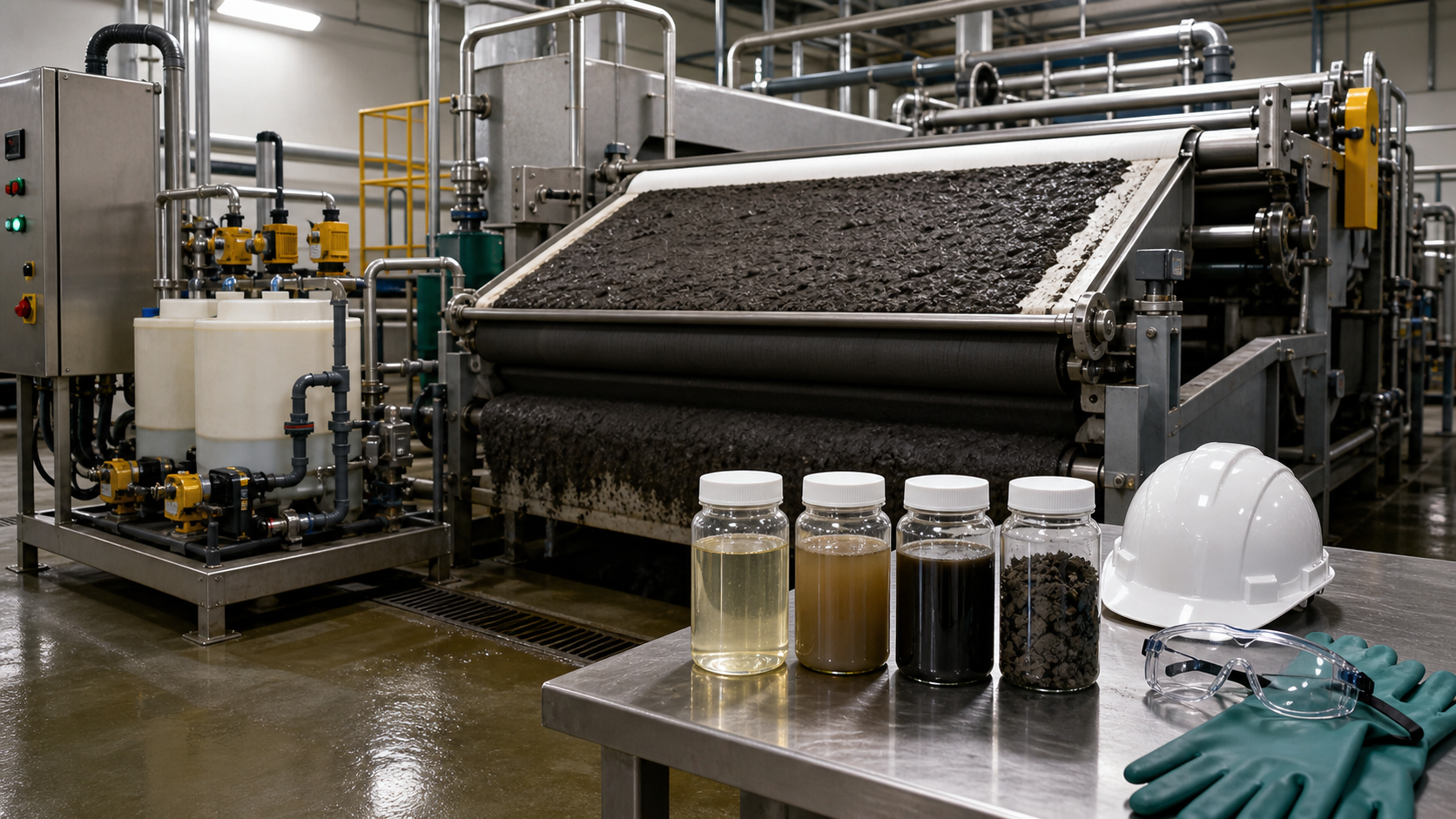
A reliable sludge dewatering program starts with polymer hydration, controlled dosing, and real sludge testing.
Why sludge dewatering is not only a chemical problem
Waste activated sludge is difficult because it is mostly water held inside a biological and colloidal structure. The solids may look heavy in a settling cylinder, but much of the water is trapped inside floc, cells, extracellular polymeric substances, and fine particles. Mechanical pressure from a belt press, screw press, plate-and-frame press, or centrifuge cannot remove that water efficiently unless the sludge is first conditioned into a structure that releases water.
This is where cationic polyacrylamide becomes valuable. Most sewage sludge carries a net negative surface charge. A cationic polymer provides charge neutralization and polymer bridging, pulling fine particles into larger aggregates and creating drainage channels in the sludge cake. The goal is not simply to make big floc in a beaker. The goal is to create floc that survives transfer pumps, mixing zones, feed wells, and mechanical shear long enough to release water inside the dewatering equipment.
A plant that treats polymer as a commodity often misses this point. Two products can both be described as CPAM and still behave very differently because of molecular weight, charge density, dissolution behavior, active content, residual monomer control, and manufacturing consistency. That is why a supplier conversation should begin with sludge type, equipment type, current cake solids, filtrate quality, polymer make-down conditions, and the plant's operating pain points.
What a good CPAM trial should measure
The first mistake in many polymer trials is judging only by visual floc size. Large floc can look impressive and still produce a wet cake. A useful trial looks at several signals together: initial floc formation, water release speed, floc strength after gentle shear, filtrate clarity, cake release, odor or foam changes, and the dose required to maintain performance. If the plant has a belt press, operators should note belt blinding and wash water demand. If the plant uses a centrifuge, they should compare centrate clarity, torque, bowl loading, and cake dryness.
Laboratory screening is still useful. It narrows the candidate list before a plant trial. The lab should use fresh sludge when possible, realistic polymer solution concentration, and a mixing method that does not exaggerate performance. Overly aggressive mixing can make weak products look better than they will be in the plant. On the other hand, under-mixing can punish a polymer that would perform well with proper dispersion. The test procedure should imitate the plant's actual contact time and mixing intensity as closely as practical.
Once a small number of candidates perform well in the lab, a plant trial should run long enough to include normal feed variation. One hour of good performance is not proof. Sludge age, return activated sludge concentration, primary sludge ratio, temperature, and industrial inflow can change throughout the day. A disciplined trial records baseline conditions first, then changes one variable at a time. The operator should avoid changing polymer, feed rate, belt speed, centrifuge settings, and wash water pressure all at once.
Make-down quality is often the hidden failure point
Dry polyacrylamide must be fully hydrated before it can perform. If powder is wetted too quickly, it can form fisheyes: gel-coated particles with dry polymer inside. These particles pass through the system as inactive polymer, creating waste, blockages, inconsistent performance, and sometimes a slimy cake. A plant may blame the product when the real issue is wetting, aging time, dilution water, or mechanical shear.
Good make-down practice usually includes controlled powder feed, adequate wetting, enough maturation time, gentle aging, and final dilution before dosing. The exact concentration depends on the system, but many plants use stock solutions in a narrow range and then dilute before injection. Too concentrated a solution can be hard to disperse. Too dilute a solution can overload pumps and reduce control. The supplier should be able to discuss typical solution concentration and aging time for the recommended grade.
Water quality also matters. Hardness, iron, salinity, temperature, and suspended solids in make-down water can affect hydration. Cold water slows dissolution. Dirty water introduces particles that consume polymer before it reaches the sludge. A good polymer program therefore checks the make-down skid as carefully as the dewatering equipment.
Choosing charge density and molecular weight
Charge density affects how strongly the polymer neutralizes sludge particles. Low charge products may not destabilize the sludge enough. Excessive charge can create restabilization, overdosing sensitivity, or poor cake release. Molecular weight influences bridging strength and solution viscosity. Very high molecular weight products can build strong floc, but they may be more shear-sensitive and slower to dissolve.
The right balance depends on sludge character. Waste activated sludge often needs a cationic product with enough charge to neutralize biological solids. Mixed primary and secondary sludge may require a different charge density. Digested sludge can behave differently from fresh sludge because digestion changes particle structure and surface chemistry. Plants that receive industrial wastewater may need additional screening because oils, surfactants, metals, or cleaning chemicals can interfere with polymer performance.
A focused reference for cationic products is cationicpolyacrylamide.com, while the main factory reference for samples and product discussion is Xinqi Polymer. These links should support a trial plan, not replace one. The plant still needs to test the grade against its own sludge.
Common symptoms and what they usually mean
If the cake is wet and soft, the plant may be underdosing, using a low-charge product, feeding sludge too quickly, or failing to give the polymer enough contact time. If the filtrate is cloudy but the cake looks dry, floc may be breaking under shear or the equipment may be overloaded. If the cake is slippery and the filtrate foams, overdose or poor dilution may be involved. If performance changes every shift, make-down inconsistency, sludge variability, or poor calibration should be investigated before blaming the polymer itself.
Operators should also watch the polymer injection point. Injecting too close to the dewatering equipment may not allow enough mixing. Injecting too far upstream may expose the floc to pump shear. The best point is often a compromise: enough energy for dispersion, enough contact time for conditioning, and minimal destructive shear before the sludge reaches the press or centrifuge.
Small mechanical issues also matter. Belt tension, belt cleanliness, spray nozzle condition, centrifuge scroll differential, polymer pump pulsation, and sludge feed consistency can all influence results. Chemical optimization cannot compensate forever for poorly maintained equipment.
Building an operating window instead of chasing a perfect dose
One of the most useful outcomes of a polymer study is an operating window. Operators need to know the normal dose range, the warning signs of underdose, the warning signs of overdose, and the adjustment steps that should be taken before calling the supplier. A single recommended number is rarely enough because sludge conditions move. A morning dose may not be correct after a storm event, a digester upset, or a change in primary sludge ratio.
A practical operating window includes at least three conditions. The first is normal loading, where the plant can target the lowest dose that maintains filtrate clarity and cake release. The second is stressed loading, where the dose may need to increase temporarily because solids concentration, grease, filamentous material, or industrial input has changed. The third is recovery, where the dose should be reduced again once the sludge returns to normal. Without the recovery step, plants often drift into permanent overfeed.
Operators should record dose changes in a simple log with sludge feed rate, polymer solution concentration, cake appearance, filtrate appearance, and equipment settings. This does not need to be complicated. Even a clear shift log can reveal patterns that are invisible during daily firefighting. For example, a plant may discover that polymer performance drops every Monday after weekend storage, or that cake release worsens when the polymer stock solution is aged too long.
What purchasing teams should understand
Purchasing teams often see polymer as a cost line, while operations teams see it as a process control tool. Both views are valid, but they must be combined. The cheapest polymer per kilogram may not be cheapest per ton of dry solids handled. If a lower-cost product requires a higher dose, produces wetter cake, increases wash water use, or causes more operator intervention, it may raise the real cost of dewatering.
A stronger purchasing comparison looks at total cost. Include polymer dose, delivered price, active content, cake solids improvement, hauling cost, disposal fee, filtrate quality, labor impact, and downtime risk. A one percentage point increase in cake solids can be worth more than a small price difference in polymer. Plants with high hauling or landfill costs should be especially careful about judging polymer only by purchase price.
It is also worth separating trial material from routine supply. Trial samples should be clearly identified by grade and batch. After the trial, the first commercial shipment should be checked against the tested sample. This protects the plant from approving one product and receiving another. A professional supplier should be comfortable with this level of traceability.
Supplier selection for sewage plants
For sewage plants, supplier selection should include more than price. A good supplier can explain why a grade is recommended, provide a realistic sample quantity, discuss make-down practice, supply documentation, and repeat the same product quality in future shipments. Buyers can use broader references such as polyacrylamide supplier, polyacrylamide supplier information, and polyacrylamide manufacturers to structure their comparison, but the final decision should depend on plant data.
Factory-direct procurement also requires practical checks. Confirm bag size, moisture protection, batch traceability, shelf life, documentation, and export packaging. Dry PAM absorbs moisture and should be stored in a dry area away from damaged pallets or open doors. A product that performs well during the trial can still become a problem if packaging is weak or storage is careless.
The most reliable dewatering programs are boring in the best way: the product hydrates predictably, the dose changes gradually, the cake releases cleanly, filtrate quality remains acceptable, and operators do not need to fight the system every shift. That level of stability is the real target of a CPAM program.