Reviewed
Long guide / clarifier stressSewage Clarifier Bulking Control with Polymer Support
Polymer cannot cure every biological bulking problem, but it can be a useful temporary support tool when clarifiers face weak floc, hydraulic stress, or solids carryover risk.
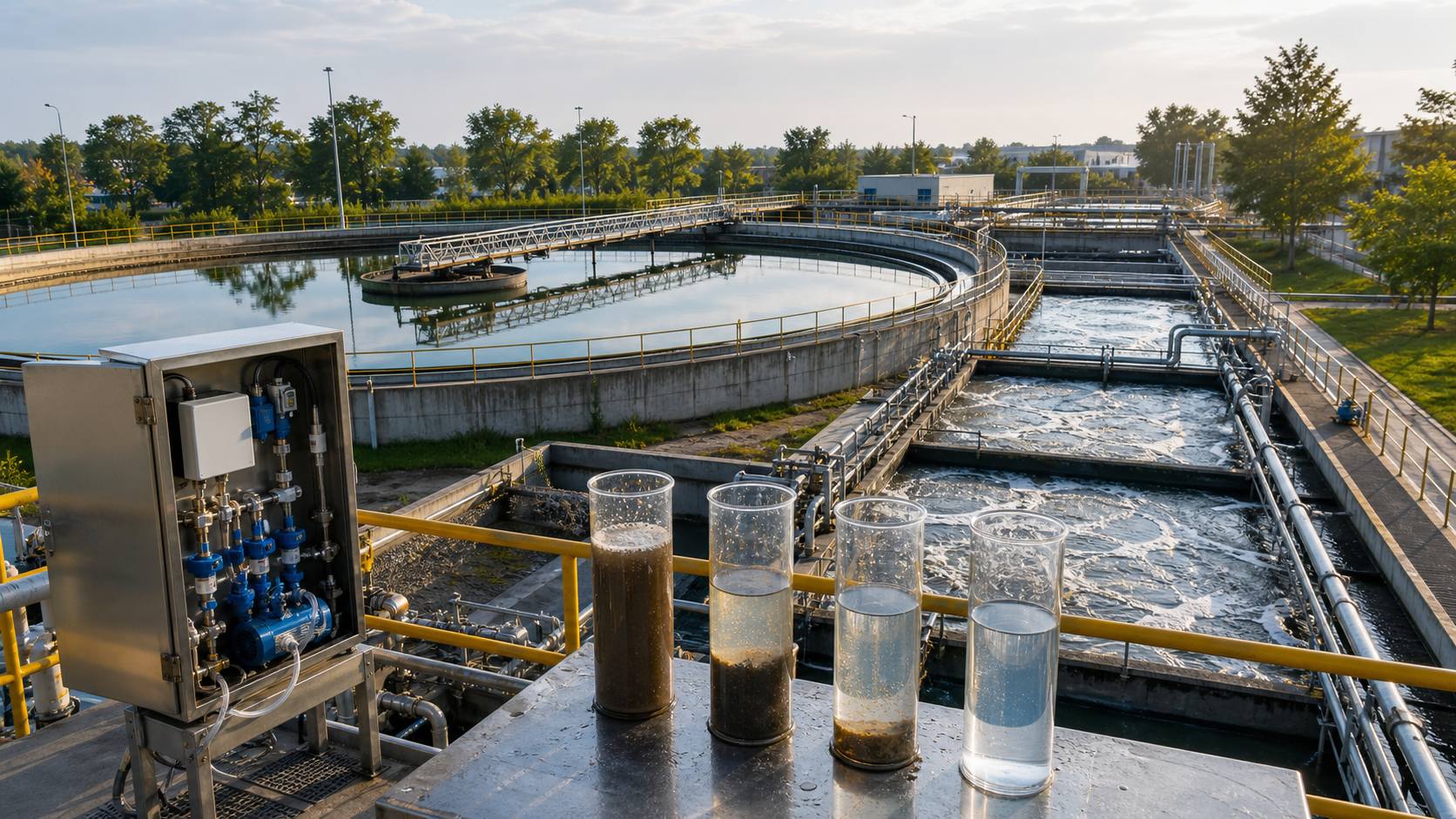
Clarifier polymer support should be tested carefully because the goal is stable solids capture, not simply larger floc in a jar.
Clarifier bulking is a process warning
Bulking in a sewage treatment plant usually means the biological solids are not settling as expected. Filamentous organisms, nutrient imbalance, low dissolved oxygen, septic influent, industrial surfactants, temperature shifts, or hydraulic overload can all reduce settling performance. When clarifier sludge blankets rise, operators need to protect effluent quality while the root cause is diagnosed.
Polyacrylamide can help by strengthening floc and improving capture of suspended solids, but it should not be treated as a permanent substitute for biological control. A polymer program is most useful as a support measure during stress periods, peak loading, plant trials, or controlled correction. For grade discussion and factory support, the main reference remains Xinqi Polymer.
The plant must first define the symptom. Is the clarifier losing pin floc, light biological floc, grease-associated solids, or chemically precipitated particles? Is the issue poor settling, rising sludge, denitrification, hydraulic short-circuiting, or blanket management? Polymer selection depends on the answer.
When cationic and anionic PAM may be considered
In many biological sludge systems, a cationic polyacrylamide grade may be screened because it can neutralize negative surface charge and build stronger floc. In other cases, especially where inorganic particles, coagulant-treated water, or certain clarification duties are involved, anionic polyacrylamide may deserve testing. There is no universal answer because wastewater chemistry changes by plant.
A jar test should include several charge levels and molecular weights, but it should also imitate plant conditions. Overmixing can make weak floc appear strong. Undermixing can make a suitable product look ineffective. The best screening method uses real wastewater, realistic dose ranges, controlled mixing, and observation after shear. A floc that forms beautifully and then breaks during transfer may fail in the clarifier.
Operators should compare not only supernatant clarity, but also settling speed, sludge volume, floc compactness, dose sensitivity, and any foam or floating material. Clarifier polymer support must be gentle enough not to create new operating problems.
Responsible use during peak load
Storm events, holiday flows, industrial discharges, and seasonal load changes can push clarifiers outside their normal comfort zone. During these periods, polymer may help the plant keep solids in the system long enough to recover. However, dose control matters. Excess polymer can create sticky sludge, interfere with return activated sludge behavior, or increase downstream dewatering demand.
A temporary support plan should specify where polymer is injected, how dose is adjusted, what effluent or blanket signals trigger changes, and when the plant should reduce or stop the dose. Without a stop rule, a temporary program can quietly become a permanent chemical expense.
The plant should also consider where the captured solids go. If more solids are retained in the clarifier, wasting strategy may need adjustment. A polymer program that improves effluent clarity but overloads sludge handling is not optimized; it has only moved the problem.
Injection point and mixing limits
Clarifier applications are sensitive to mixing. The polymer must disperse into the flow before the settling zone, but excessive turbulence near the clarifier can break floc or create uneven distribution. Some plants test polymer upstream of a splitter box, before a flocculation zone, or at a controlled channel point. The best location depends on hydraulics and available contact time.
Field observation is essential. If floc forms in one part of the flow and not another, the injection point may be creating uneven treatment. If the treated water forms ropes or gels, the polymer solution may be too concentrated or poorly diluted. If the clarifier improves at low flow but fails at high flow, mixing energy and contact time should be checked before increasing dose.
Polymer make-down quality also affects clarifier work. Poorly hydrated polymer can behave unpredictably and may leave visible strings or gels. Plants that already use polymer for sludge dewatering should not assume the same solution concentration, aging time, or injection strategy will work in clarification.
Combining polymer support with biological correction
When bulking is biological, the long-term answer is usually process correction: dissolved oxygen control, nutrient balance, selector performance, sludge age management, return rates, wasting strategy, and industrial source control. Polymer can protect the effluent during the correction period, but it should be connected to the biological action plan.
Good records make this possible. Track sludge volume index, microscopic observations, clarifier blanket depth, return activated sludge concentration, mixed liquor concentration, effluent suspended solids, polymer dose, and weather or industrial events. After several weeks, the plant can separate chemical benefit from biological recovery.
The best clarifier polymer programs are humble. They acknowledge that polymer is a tool, not a miracle. Used carefully, it can reduce solids loss during stress, buy time for process correction, and help operators understand how floc strength responds to controlled treatment. Used carelessly, it can add cost and confusion. The difference is testing, dose discipline, and plant-specific observation.