Reviewed
Long guide / clarificationMunicipal Clarifier Optimization with PAM: From Jar Test to Plant Trial
Clarifier problems are rarely caused by one factor. Hydraulic loading, sludge settleability, filamentous growth, return sludge control, industrial inflow, storm dilution, and polymer selection can all affect solids capture. Polyacrylamide can help, but only when it is used as part of a controlled process strategy.
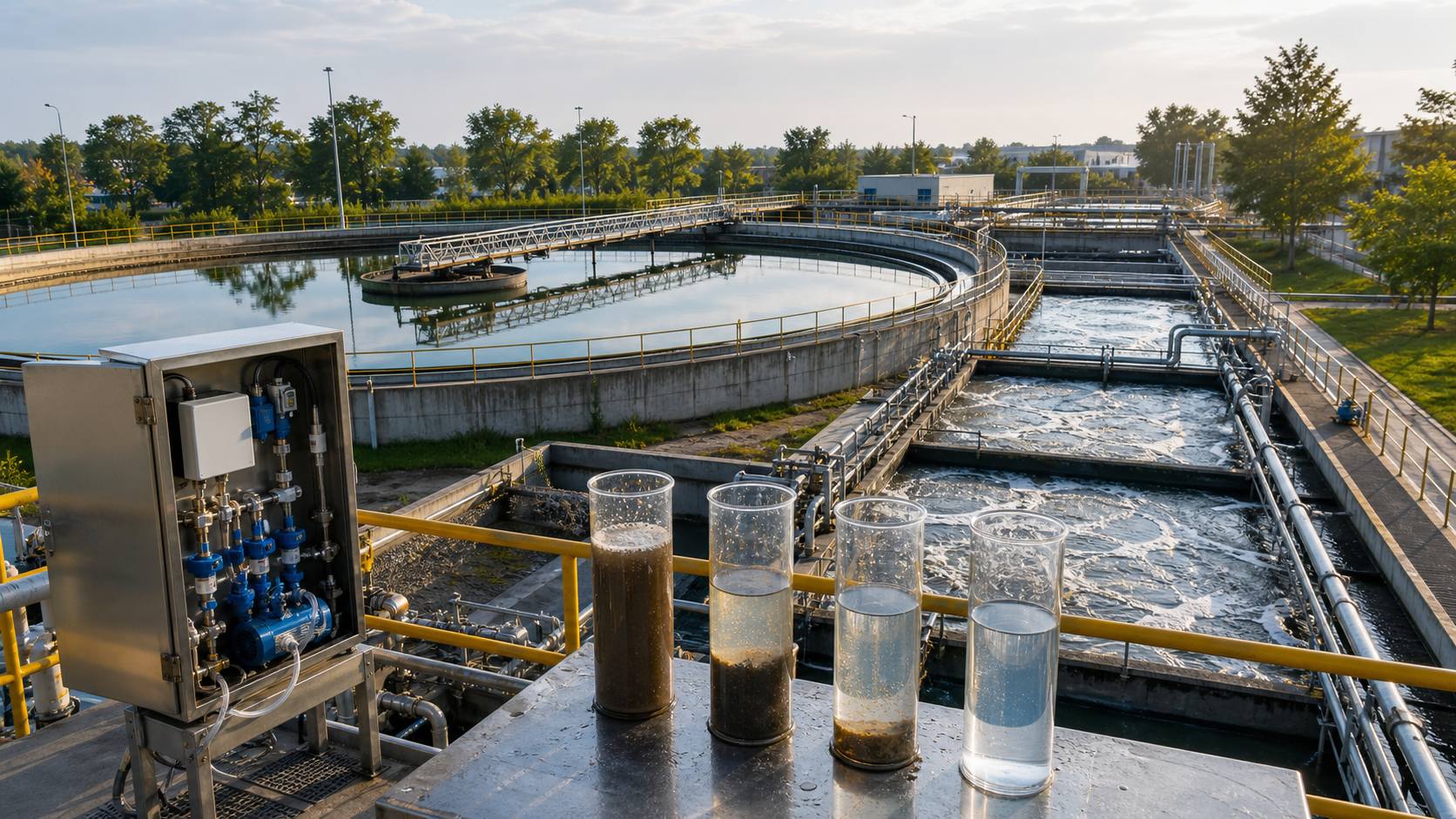
Clarifier polymer trials should compare overflow clarity, sludge blanket behavior, and floc resilience under realistic plant conditions.
What clarifier stress looks like before failure
A secondary clarifier does not usually move from good performance to failure instantly. Operators often see warning signs first: a rising sludge blanket, cloudy overflow, pin floc escaping the weirs, poor sludge compaction, variable return activated sludge concentration, or sensitivity to small hydraulic changes. During wet weather, the same clarifier may look stable in the morning and stressed by afternoon. During biological upsets, the floc may become light, open, and difficult to settle even when hydraulic load is normal.
Polyacrylamide can support solids capture by strengthening floc and improving settling, but it cannot solve every upstream problem. If dissolved oxygen control, sludge age, nutrient balance, filamentous organisms, or return sludge pumping are poorly managed, polymer may only hide symptoms for a short time. A serious optimization plan therefore begins with plant data, not with a chemical feed pump.
Before testing polymer, the plant should document baseline turbidity or TSS, sludge blanket depth, SVI, MLSS, RAS concentration, flow rate, wet-weather behavior, and any industrial discharge patterns. Without a baseline, it is easy to misread a trial. A product may look successful because the plant load improved naturally during the test window, or it may look poor because the plant entered a shock load just as the trial began.
Where PAM fits in a clarifier program
PAM can be used in several ways around clarification. In primary treatment, it may help capture fine suspended solids and reduce downstream load. In secondary clarification, it may support floc strength during difficult settling periods. In tertiary clarification or polishing systems, it may help produce a lower-turbidity effluent before filtration. Each location requires a different product choice and dosing strategy.
Anionic polyacrylamide is often considered where mineral solids or inorganic particles dominate. Cationic polyacrylamide is more common around biological sludge and organic solids. Nonionic products can be worth screening where the water chemistry is unusual or where charge effects need to be minimized. A practical selection page should not treat these as marketing categories only. They are different tools for different particle systems.
For product-family background, buyers can review anionic polyacrylamide, cationic polyacrylamide, and nonionic polyacrylamide. For factory samples and direct product discussion, use Xinqi Polymer.
Jar testing for clarifier support
A clarifier jar test should do more than show that solids settle. It should compare the rate of floc formation, the size and density of floc, the clarity of the supernatant, and the behavior of the floc after gentle disturbance. If the floc breaks easily, it may not survive plant mixing. If it settles quickly but creates a fluffy sludge layer, the clarifier may still struggle with blanket control. If the supernatant clears only at a high dose, the cost and overdose risk may be unacceptable.
The test water should be representative. For secondary clarification, mixed liquor from the aeration basin may be more relevant than final effluent. For primary clarification, raw or chemically conditioned influent may be required. If stormwater dilution is the problem, a plant may need to test during wet-weather conditions rather than relying on dry-weather samples. The more closely the test matches the actual problem, the more useful the result will be.
Dose ladder design matters. Start with low doses and increase gradually. Record the point where floc first improves, the point where supernatant clarity improves, and the point where overdose symptoms appear. Overdose may show as fine floc carryover, cloudy water after initial clearing, sticky sludge, or poor settling after restabilization. The best dose is usually not the highest dose. It is the lowest dose that gives reliable performance under the plant's expected variation.
Moving from jar test to plant trial
A plant trial should be planned like a controlled operating change. Define the feed point, solution concentration, initial dose, adjustment interval, success criteria, and stop conditions before the trial begins. Operators should know what they are allowed to change and what should remain constant. If possible, run the trial during a period that represents normal stress, not only ideal conditions.
The feed point should provide enough mixing for polymer dispersion without destroying newly formed floc. In some systems, the best feed point is upstream of a flocculation zone. In others, polymer should be added closer to the clarifier inlet. Too much shear after polymer addition can break floc. Too little mixing can leave polymer streaks and uneven treatment. Trial data should include notes about mixing and visible dispersion, not only lab numbers.
During the trial, track effluent turbidity or TSS, sludge blanket depth, RAS concentration, flow rate, chemical dose, and operator observations. If the plant has online turbidity, the trend is useful, but grab samples and visual inspection still matter. A short-term drop in turbidity is encouraging, but the trial should also show that the clarifier remains stable as load changes.
Understanding when polymer is the wrong answer
A professional optimization plan also defines when polymer should not be the primary response. If the plant is losing solids because return sludge pumps are undersized, polymer may reduce carryover for a while but it will not fix the hydraulic imbalance. If the sludge blanket is rising because wasting has been too low for too long, polymer may make the blanket look temporarily stronger while the biological inventory remains excessive. If filamentous bulking is severe, polymer can help capture solids, but process control must still address the biological cause.
This distinction matters for credibility. A plant manager is more likely to trust a polymer recommendation when it is honest about limits. The best chemical program supports the treatment process; it does not pretend to replace operations. A supplier that immediately recommends a high dose without asking about SVI, MLSS, sludge age, flow variation, or current clarifier condition is not providing enough technical support.
There are also cases where a plant should trial a coagulant and polymer combination instead of polymer alone. Certain colloidal or phosphorus-related problems respond better when charge neutralization and bridging are staged. However, adding chemicals blindly can create more sludge, change alkalinity, and affect downstream dewatering. Any combined program should be tested carefully and reviewed against the plant's permit goals.
Designing records that survive staff turnover
Many wastewater plants lose process knowledge when experienced operators retire or move. A polymer program should therefore leave behind records that a new operator can understand. The record should include the tested product, supplier contact, make-down settings, feed point, normal dose range, emergency dose range, typical response time, and known failure symptoms. Photos of good floc, poor floc, normal blanket, and carryover conditions can be surprisingly useful.
Good records also help prevent repeated trials of the same idea. If a plant has already tested a low-charge product and found that it failed during storm flow, that result should be documented. If a high-charge product improved clarity but caused sludge handling problems, that tradeoff should also be documented. This turns polymer selection from guesswork into institutional memory.
For SEO and user value, this kind of detail matters as well. Real operators search for practical troubleshooting information, not just product names. A page that explains how to test, where mistakes happen, and what data to record is more likely to attract useful visitors than a page that only repeats "high-quality polyacrylamide" many times.
Supplier and procurement considerations
Municipal plants often need more than one product conversation. They may need a clarification aid, a dewatering polymer, and a backup grade for difficult seasons. Supplier capability therefore matters. A buyer should ask whether the supplier can provide samples, documentation, recommended make-down conditions, product consistency, and practical guidance for both clarification and sludge dewatering.
Helpful procurement references include polyacrylamide supplier, polyacrylamide supplier information, polyacrylamide manufacturers, and China polyacrylamide factory. These resources can help organize supplier comparison, but the winning supplier still needs to prove performance in the plant's actual water.
Plants should also consider storage and handling. Dry PAM must be protected from moisture. Emulsion products, if used, have their own storage and activation requirements. Operators need clear instructions, and purchasing teams need to understand that a cheaper product can become expensive if it requires more dose, creates unstable operation, or arrives inconsistently between batches.
What a professional result looks like
A successful clarifier polymer program does not make the plant dependent on chemical overuse. Instead, it gives the operator another controlled tool. The plant should see more stable overflow clarity, a more predictable sludge blanket, better response during peak loading, and a clear understanding of when polymer should be used and when process control should be corrected upstream.
The final recommendation should include product grade, dose range, make-down concentration, feed point, monitoring signals, and adjustment rules. It should also state the limits of the recommendation. If the plant enters a severe biological upset, polymer alone may not maintain compliance. If hydraulic loading exceeds design, chemical support may reduce symptoms but cannot change the clarifier's physical capacity.
In short, PAM is most valuable when it is selected with discipline. Test the water that actually causes problems. Compare polymer families. Run a careful plant trial. Record the operating conditions. Then choose the supplier and grade that provide stable performance, not just the most dramatic jar.